
Crawler Drilling Rigs
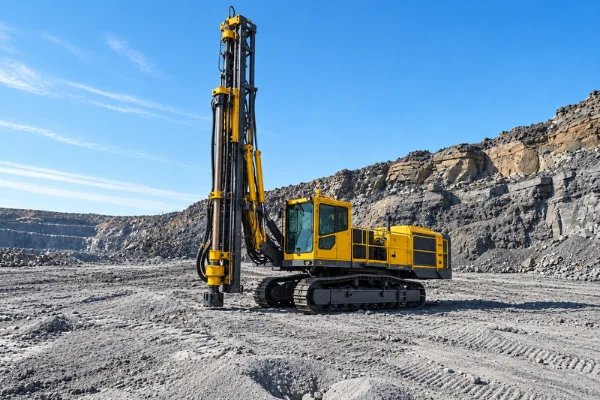
Crawler drilling rigs are tracked drilling machines designed for projects where equipment must move across uneven, unpaved, or difficult work areas. Instead of depending on a road-going chassis, the rig uses a crawler undercarriage to move between drilling positions and establish a working position at the site.
This configuration is useful for borehole drilling, quarry work, mining projects, construction drilling, and other operations involving multiple drilling locations or challenging site access. Synergy Rigs Nigeria Provides crawler drilling rigs in Nigeria with different drilling capacities, machine dimensions, mast configurations, and tracked undercarriages to suit project and terrain requirements.
Crawler Drilling Rigs
Crawler drilling rigs are tracked drilling machines designed for projects where equipment must move across uneven, unpaved, or difficult work areas. Instead of depending on a road-going chassis, the rig uses a crawler undercarriage to move between drilling positions and establish a working position at the site. This configuration is useful for borehole drilling, quarry work, mining projects, construction drilling, and other operations involving multiple drilling locations or challenging site access. Synergy Rigs Nigeria supplies crawler drilling rigs in Nigeria with different drilling capacities, machine dimensions, mast configurations, and tracked undercarriages to suit project and terrain requirements.
Crawler Rig Design for Difficult Site Conditions
The tracked undercarriage is one of the main differences between a crawler drilling rig and truck-mounted or wheeled equipment. Crawler tracks provide a larger ground-contact area and allow the machine to move independently around suitable work areas. This is particularly useful where roads have not been fully developed or where the drilling points are located away from normal vehicle access.
Crawler rigs can be considered for sites with:
- Uneven working surfaces
- Unpaved access routes
- Quarry and mining areas
- Construction sites
- Remote drilling locations
- Multiple drilling points across one project
Terrain capability still depends on the individual machine. Track dimensions, machine weight, ground clearance, slope limits, and ground conditions should be checked before selecting a rig.
Rig Positioning Between Multiple Drill Points
A crawler-mounted machine can reposition without being loaded onto a separate transport vehicle for every move within the worksite. This can simplify movement between holes and reduce unnecessary handling of the complete drilling system.
When evaluating site mobility, contractors should consider the distance between holes, available turning area, surface condition, obstacles, and the space required to align the machine at each drilling point.
Many crawler drilling applications require the machine to complete one hole and then move a relatively short distance to the next drilling position.
This is common in quarry, mining, exploration, and site-investigation work where drilling points may follow a planned pattern or grid.
Undercarriage and Ground Contact Requirements
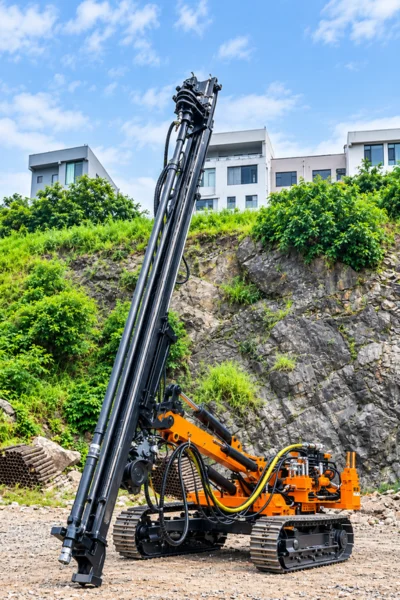
A crawler system should therefore be evaluated according to the actual worksite rather than simply choosing the largest available undercarriage. A compact machine may be more practical in restricted areas, while a larger platform may be required to support heavier drilling equipment.
Track width, track length, and total machine weight influence how the load is transferred to the ground. This becomes important when operating on loose, soft, or irregular surfaces.
The objective is to achieve an appropriate balance between machine stability, site mobility, drilling capacity, and transportability.
Ground clearance also affects the machine's ability to move over small obstacles and uneven terrain.
The crawler undercarriage supports the complete drilling machine during movement and positioning.
Stability on Slopes and Uneven Ground
Slope angle, surface strength, loose material, excavation edges, and machine orientation can all affect stability. The mast position can also change the way loads act on the machine during drilling.
For projects involving irregular terrain, buyers should review the manufacturer's permitted operating gradients and positioning requirements for the specific rig.
A crawler rig may be able to travel over irregular terrain, but the machine still needs an acceptable operating position before drilling starts.
Site preparation may still be necessary where the natural ground does not provide an adequate drilling position.
Reaching a drilling location and safely operating at that location are two different requirements.
Transporting Crawler Drilling Rigs Between Development Environment
Crawler rigs are designed primarily for movement around the drilling site rather than long-distance road travel. When the machine needs to move from one project to another, suitable transport equipment is normally required. The transport arrangement should account for the rig's total weight and dimensions in its transport configuration. Loading and unloading also need to be considered, particularly for larger machines. This is one of the main operational differences between crawler and truck-mounted drilling equipment. For contractors regularly working across separate projects, it is useful to establish:
Access conditions at the destination
Transport width and height
Suitable hauling equipment
Frequency of mobilisation
Loading requirements
Rig transport weight
Why Choose Crawler Drilling Rigs?
Adaptable drilling capability
Different configurations and tooling can support varying depths, diameters and formations.
Practical for changing drilling locations
The crawler platform can reposition within a worksite as the drilling programme progresses.
Flexible site deployment
Suitable for construction, mining, quarrying, geotechnical and borehole projects.
Stable drilling platform
The tracked base supports controlled positioning during drilling operations.
Reduced dependence on prepared roads
The rig can operate within suitable internal site routes and open terrain.
Better off-road mobility
Tracks allow the rig to reach many uneven and undeveloped drilling areas.
Frequently Asked Questions
1. What is a crawler drilling rig?
A crawler drilling rig is a drilling machine mounted on a tracked undercarriage. It is designed to combine drilling capability with mobility across uneven or off-road terrain.
2. Where are crawler drilling rigs commonly used?
They are used for geotechnical investigation, borehole drilling, mining, quarrying, construction, anchoring and infrastructure-related drilling.
3. Can crawler rigs drill on sloping ground?
They can operate on suitable slopes when the rig's climbing capability, stability and ground conditions are within the manufacturer's operating limits.
4. Are crawler rigs suitable for water well drilling?
Yes. Suitable crawler rigs can be equipped for water well and borehole drilling, particularly where the drilling location has limited road access.
5. How are crawler drilling rigs transported between sites?
Although they can travel within suitable worksites, longer-distance movement generally requires transport equipment because crawler rigs are not designed for normal road travel like truck-mounted units.
6. What determines crawler rig drilling depth?
Depth depends on the rig's feed system, mast capacity, drill rod arrangement, drilling method, tooling and geological conditions.
7. Can crawler rigs be used for hard-rock drilling?
Yes, when the rig is equipped with an appropriate drilling system and tooling for the expected formation, such as DTH or other suitable rock-drilling methods.
8. What should be checked before deploying a crawler rig?
The drilling depth, formation, hole diameter, site slope, ground condition, access width, machine dimensions, transport route and required auxiliary equipment should all be evaluated.