
Mining & Exploration Drilling Rigs
Mining and exploration drilling rigs are used to investigate subsurface geology, obtain geological samples, define mineral targets, and support different stages of mineral exploration and mine development. Unlike general borehole drilling, exploration drilling is primarily concerned with the geological information obtained from each hole. Drilling depth is important, but sample requirements, hole orientation, geological conditions, drilling method, and the scale of the exploration programme can be equally important when selecting equipment. Synergy Rigs Nigeria Provide mining and exploration drilling rigs in Nigeria for geological investigation, mineral exploration, and mining-related drilling projects.
Drilling Equipment for Different Stages of Mineral Projects
Drilling requirements can change as a mineral project progresses.
Early-stage exploration may involve drilling across a wider area to investigate geological targets and identify zones requiring further study. More detailed programmes can require closer-spaced holes, deeper drilling, or improved geological sample recovery. As a project advances, drilling may also support resource definition, mine planning, and other geological investigations.
For this reason, mining and exploration rigs should be selected around the actual programmed rather than simply choosing the machine with the greatest stated drilling depth. Important programmed factors include the number of planned holes, expected depths, geological target, sampling requirements, drilling orientation, terrain, and frequency of rig movement.
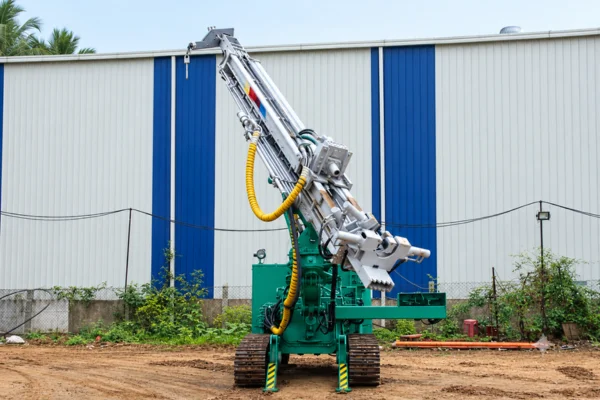
Exploration Drilling Methods and Sample Requirements
Core Drilling
Core drilling recovers cylindrical sections of rock that allow geologists to examine the formation in greater detail. The recovered core can provide information about lithology, geological contacts, fractures, structures, and mineralised intervals. Where continuous core recovery is required, the rig must be compatible with the intended coring system, drill rods, and sample-retrieval arrangement. Detailed core sizes, wireline equipment, and core tooling are covered separately under
Core Drilling Rigs.
Reverse Circulation Drilling
Reverse circulation drilling is used in mineral exploration to return rock chips to the surface through the drilling system. The method requires equipment configured for the required air supply, drill string, sampling arrangement, and geological conditions. Where RC drilling is planned, the complete drilling and sample-return system should be considered rather than evaluating the rig alone.
Other Exploration Drilling Requirements
Some geological programmes may use other drilling methods depending on the formation, target, required information, and project stage. The method should be established before final rig selection because different drilling systems can require substantially different tooling and supporting equipment.
Resource Definition and Geological Investigation
After an exploration target has been identified, additional drilling may be required to understand its size, continuity and geological characteristics. Drilling locations are planned across the target area to build a more detailed subsurface model.
At this stage, consistency becomes important. Similar drilling conditions, controlled hole placement and reliable sample recovery can help produce comparable information across multiple drill holes.
Mining Drilling by Project Stage
Drilling requirements can change as a mineral project progresses.
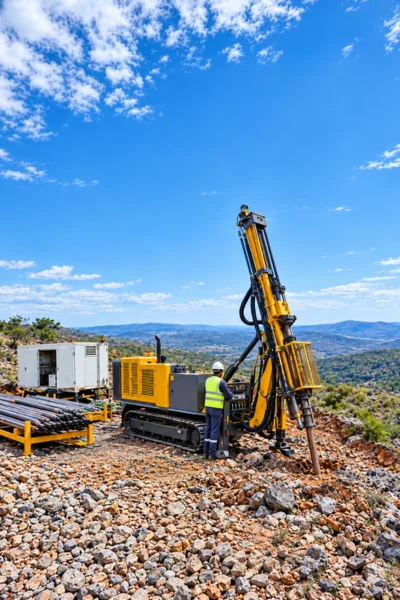
Operational Mining
Specialised drilling equipment can support production and other mine-site activities where the drilling objective requires dedicated hole patterns or controlled placement.
Detailed Exploration
Additional holes are positioned around identified targets to understand mineralisation, geological structures and continuity.
Early-Stage Exploration
Initial drilling investigates selected geological targets and helps determine whether further exploration is justified.
Resource Definition
More systematic drilling provides information used to develop a detailed understanding of the mineralised zone.
Mine Development
Drilling may support geotechnical investigation, geological confirmation and planning of future mining areas.
Rig Capability for Remote and Demanding Developments
Mining and exploration programmed frequently operate away from established infrastructure. Remote locations may require equipment that can be transported efficiently, positioned on uneven ground and supported with the necessary air, water, power and tooling systems. Equipment planning should therefore consider the complete drilling operation rather than the rig alone. Transport, consumables, drill rods, compressors, pumps, tooling and maintenance access can all influence field productivity.
Why Choose Our Mining & Exploration Drilling Rigs?
Matched to the drilling objective
Equipment can be selected according to exploration, investigation, development or production needs.
Built around field productivity
Equipment selection considers mobilisation, drilling continuity and practical site operation.
Integrated equipment planning
Drilling performance depends on the complete combination of rig, tooling and auxiliary systems.
Flexible drilling applications
One equipment range can support different stages of mining and exploration programmes.
Suitable for demanding environments
Platforms can be selected for surface, remote and challenging field locations.
Adaptable to geological conditions
Rig and tooling selection can account for changing formations and drilling depths.
FAQs for Mining & Exploration Drilling Rig
1. What is a mining exploration drilling rig?
It is a drilling machine used to investigate subsurface geology and obtain samples or drilling information for mineral projects.
2. Which drilling methods are used for mineral exploration?
Core drilling and reverse circulation drilling are commonly used, while other methods may be selected according to geology and exploration objectives.
3. What is the difference between core drilling and RC drilling?
Core drilling recovers cylindrical rock core, while RC drilling returns rock chips through the drilling system for sampling.
4. Why are some exploration holes drilled at an angle?
Angled holes can be planned to intersect geological structures or mineralised zones in a required orientation.
5. How deep can an exploration drilling rig drill?
Depth capability depends on the rig, drilling method, drill string, hole dimensions, geology, and drilling angle.
6. Are crawler rigs used for mineral exploration?
Yes. Crawler-mounted rigs can be useful where the machine needs to move between drilling positions across undeveloped sites.
7. What equipment is required with an exploration drilling rig?
Requirements can include rods, bits, sampling tools, compressors or pumps, hoses, recovery equipment, and drilling consumables.
8. What should I provide when requesting an exploration rig?
Provide the drilling method, sample requirement, expected depth, hole angle, geology, site conditions, and planned workload.
9. How much does an exploration drilling rig cost in Nigeria?
Price depends on drilling method, capacity, sampling system, rig configuration, and supporting equipment included.