
Rotary Borehole Drilling Rigs
Rotary borehole drilling rigs use controlled rotation and feed force to advance a drill bit through the formation. Depending on the drilling system and ground conditions, air or drilling fluid can be circulated through the bore to remove cuttings and support the drilling process. Synergy Rigs Nigeria supplies rotary borehole drilling rigs in Nigeria for projects requiring different drilling depths, hole diameters, rotary capacities and circulation systems.
Rotary Drilling Principles and Operating Requirements
In conventional rotary drilling, the drill string transfers rotation and feed force from the rig to the cutting tool at the bottom of the bore.
The effectiveness of the drilling process depends on the relationship between:
- Rotary torque
- Rotation speed
- Feed force
- Bit design
- Formation characteristics
- Cuttings removal
These operating factors need to work together. Higher torque or feed force alone does not necessarily result in better drilling. The rig should provide an operating range that allows the drilling parameters to be adjusted according to the formation and tooling being used.
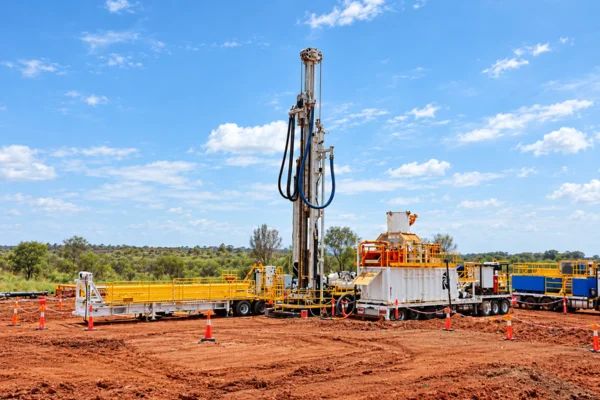
Rotary Drill Bit Selection for Different Formations
The drill bit determines how mechanical energy from the rig is applied to the formation.
01. Formation-Specific Rotary Tooling
Other rotary tooling may be used where the geology, bore dimensions or project requirements call for a different cutting arrangement. Bit selection should therefore be based on formation characteristics and drilling requirements rather than diameter alone.
02. Roller-Cone Bits
Roller-cone bits use rotating cones and cutting structures to break the formation as the drill string turns. Different cutting structures can be selected according to the expected drilling conditions.
03. Drag-Type Bits
Drag bits use cutting elements to shear and scrape suitable softer formations. Their application depends on ground conditions and the required bore diameter.
Cuttings Removal and Borehole Circulation Systems
Material produced by the drill bit must be removed continuously from the bottom of the bore. Rotary drilling systems can use air or drilling fluid to transport cuttings toward the surface. Required circulation capacity depends on factors including bore diameter, drill-string dimensions, depth and formation characteristics. Effective circulation helps:
Reduce accumulation around the bit
Support suitable bore conditions
Clean the bottom of the bore
Maintain continuous drilling
Remove drilled material
Water Well Rigs for Different Supply Requirements
The intended use of the groundwater influences the scale of the project and the required well output.
| Application | Why Rotary Drilling Suits the Application | Typical Ground / Requirement |
|---|---|---|
| Water Well Drilling | Provides controlled drilling through overburden and water-bearing formations | Sand, clay, gravel and weathered ground |
| Agricultural Boreholes | Suitable for developing groundwater wells across many soil formations | Alluvial and mixed formations |
| Commercial Water Wells | Supports larger-diameter borehole construction where formation allows | Soil, sediment and weathered zones |
| Geotechnical Investigation | Allows controlled penetration and investigation of subsurface layers | Soil and weathered formations |
| Environmental Monitoring Wells | Can be configured for controlled borehole construction | Soil, sand and unconsolidated formations |
| Foundation Investigation | Creates boreholes for understanding subsurface conditions | Soil, clay, gravel and weathered rock |
| Construction Drilling | Supports selected anchor, micropile and related drilling work | Suitable soil and mixed ground |
| Exploration Drilling | Provides access to subsurface formations for selected investigation programmes | Sedimentary and weathered formations |
| Dewatering Wells | Can create boreholes for selected groundwater control systems | Water-bearing soil and granular formations |
| Ground Improvement Work | Suitable for selected drilling and injection-related applications | Soil and mixed ground |
Rotary Drilling Methods and Circulation Systems
Rotary drilling can be configured with different circulation approaches according to the formation and drilling objective.
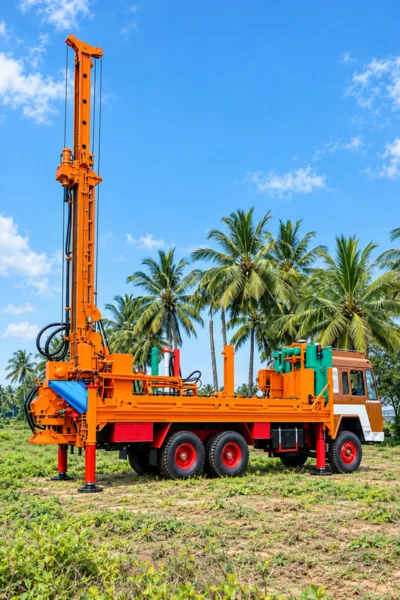
Mud Rotary Drilling
Mud rotary systems circulate drilling fluid through the drill string and back up the borehole. The fluid can help remove cuttings and provide support in formations where borehole stability is a concern.
Air Rotary Drilling
Air is circulated through the drill string to remove cuttings. This approach can be effective in suitable consolidated formations and where rapid cuttings removal is required.
Combination Rotary Systems
Some drilling projects encounter changing formations. Combination systems can allow the drilling contractor to adapt the drilling approach as ground conditions change.
Water-Based Circulation
Water can be used as the circulating medium for certain drilling conditions, depending on formation stability and project requirements.
Why Choose Synergy Rigs Nigeria for Rotary Borehole Drilling Rigs?
Expert Equipment Guidance
Support in selecting a suitable rotary drilling rig based on project depth, ground conditions, and operational needs.
Reliable Drilling Performance
Designed to support consistent drilling across different soil formations and suitable rock conditions.
Versatile Project Applications
Suitable for borehole development, groundwater exploration, and water well drilling projects.
Adaptability to Nigerian Terrain
Suitable rig configurations for diverse geological conditions encountered across Nigeria.
Efficient Drilling Operations
Engineered to support productive drilling cycles and effective site operations.
Robust Equipment Construction
Built to handle demanding working environments and regular field use.
Frequently Asked Questions About Rotary Borehole Drilling Rigs
1. Which formations are best for rotary drilling?
Rotary drilling is commonly suited to soil, clay, sand, gravel, alluvial deposits and weathered or softer formations.
2. Can rotary rigs drill through rock?
Yes, depending on the rock type, bit, rig capacity and drilling system. Very hard rock may require DTH or another specialized method.
3. Is mud required for rotary drilling?
Not always. Air, water or drilling fluids may be used depending on formation stability and the drilling objective.
4. What determines rotary drilling speed?
Formation characteristics, bit type, rotary speed, feed force, torque and circulation efficiency all influence drilling rate.
5. Can rotary drilling be used for water wells?
Yes. Rotary drilling is widely used for water wells, particularly in unconsolidated and mixed formations.
6. What happens if the borehole becomes unstable?
Casing, drilling fluids or other borehole-control techniques may be required depending on the formation and well design.
7. How is a rotary rig different from a DTH rig?
A rotary rig primarily relies on continuous rotation, while a DTH system uses a downhole percussion hammer combined with rotation.
8. What information is needed to select a rotary rig?
Target depth, hole diameter, geological conditions, drilling method, circulation system, site access and expected drilling workload are key factors.